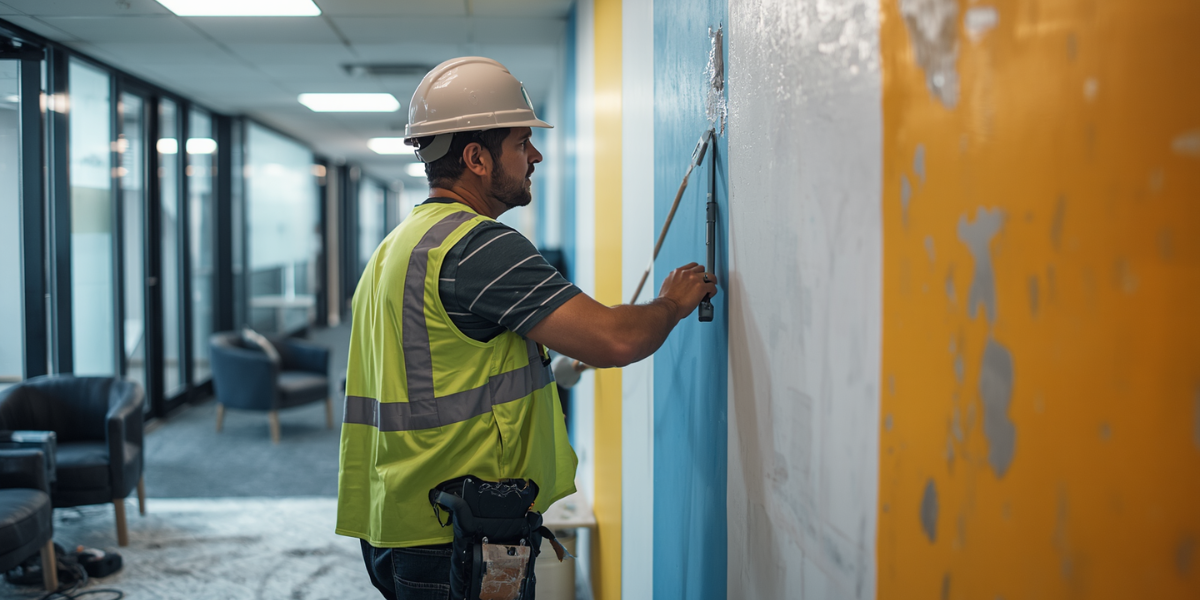

Getting your business premises painted is one of those necessary improvements that most business owners put off longer than they should — largely because the thought of the disruption seems worse than just living with tired walls for another year.
The disruption doesn’t have to be significant. With the right approach, most commercial paint jobs can be completed with minimal impact on daily operations. Here’s how.
The Core Principle: Plan the Schedule Around Your Business, Not the Painter’s Convenience
This is the starting point for every commercial painting job worth doing properly. A painting team that shows up during your peak trading hours, leaves equipment in customer areas, or expects you to work around them rather than the other way around isn’t the right fit for a commercial job.
At Icon Touch, every commercial painting job in Bankstown and South-West Sydney starts with understanding the client’s operational schedule and working backward from there. When can the space be empty? When are the peak periods? Are there particular areas that are more flexible than others?
The answers to these questions shape the entire job plan.
Option 1: After-Hours Painting
The cleanest solution for most Bankstown businesses. Work starts after the last staff member leaves and is timed to be at a stable point before anyone arrives in the morning.
How it works in practice:
- Painters arrive at your confirmed close time
- All furniture, equipment, and sensitive items are either covered or moved by a pre-agreed process
- Work proceeds through the night
- By morning, paint has had several hours to dry and fumes have been ventilated
- Staff arrive to a freshly done space with no disruption to the day
Products for after-hours work: Low-VOC and fast-dry products are essential for after-hours commercial painting. They dry faster (less risk of a wet surface in the morning), off-gas less during the job (better air quality for the painting team), and reach acceptable indoor air quality faster before staff re-enter.
Fast-dry products to know: Dulux Wash & Wear Ultra and Taubmans Endure Interior are both fast-drying, low-VOC products commonly used in after-hours commercial work in South-West Sydney.
After-hours rates: A modest premium of 10–20% above standard rates typically applies. For most businesses, this is significantly less than the cost of an hour’s lost productivity for the whole team — never mind a full day.
Option 2: Weekend and Holiday Scheduling
If after-hours isn’t workable — a 24-hour operation, security restrictions, or a space that genuinely needs 2–3 days of uninterrupted work — weekend or public holiday scheduling is the alternative.
This works particularly well for:
- Larger retail spaces that need a full weekend of work
- Restaurants and cafés that close on Mondays
- Medical practices closed on weekends
- Offices that have weekend access and want the job done in one continuous block
Planning for weekend jobs: Confirm with the building manager well in advance — many commercial buildings require prior notice for after-hours or weekend access, and lift or loading dock arrangements may need to be made.
Option 3: Staged Sections
For larger commercial spaces or businesses that genuinely can’t close any area fully, a staged approach works one section at a time while the rest operates normally.
How it’s structured:
- Map out the space into sections that can be isolated from the working area
- Agree the sequence — typically start with the areas causing most concern, or with areas that are easiest to isolate
- Each section is cordoned off (plastic sheeting, temporary barriers) while work happens
- Staff and customers continue working in the unpainted sections
- Once a section is done and dry, the barrier moves
Staged work in practice for an office: Week 1, the meeting rooms. Week 2, one wing of open plan. Week 3, the other wing and reception. The business continues throughout.
The staged approach takes longer overall — more visits, more setup and pack-down time. It costs slightly more than doing it in one hit. But it’s often the only workable option for continuously operational businesses.
Protecting Your Equipment and Assets
Before any commercial painting begins, the protection plan needs to be clear.
Standard protection included by a professional commercial painter:
- Drop sheets over floors, carpets, and furniture
- Masking tape and plastic sheeting on joinery, fittings, and equipment
- Removal of wall-mounted items (pictures, screens, shelving) where required
What you should do before the team arrives:
- Remove any valuable or irreplaceable items from work areas
- Back up any computers or servers that can’t be moved
- Secure or lock away sensitive documents
- Flag any equipment that needs special protection (medical equipment, specialist machinery, electronics)
Talk through the protection plan with your painter before the job starts — not the morning it begins.
Ventilation — The Key to Fast Re-Occupancy
Even with low-VOC products, freshly painted spaces need ventilation before they’re fully comfortable for extended occupancy. How you manage this depends on the space:
For spaces with HVAC systems: Run the HVAC on fresh air mode (not recirculate) during painting and for several hours after completion. This clears the space faster than any other method.
For spaces without central HVAC: Open all windows and doors, use portable fans to create cross-flow ventilation. The more air movement, the faster the space clears.
Typical re-occupancy timelines (with low-VOC products and adequate ventilation):
- Touch-dry: 1–2 hours
- Comfortable for short visits: 3–4 hours
- Normal occupancy: 6–12 hours
- Full cure (full washability): 7–14 days
For spaces where people will be working the next morning, confirming adequate ventilation overnight is important. This is a point worth discussing explicitly with your painter.
Communicating With Staff Before a Commercial Paint Job
Staff appreciate knowing what’s happening — particularly if they’ll arrive to a changed environment or if they need to do anything before the painters come in.
A simple staff communication should cover:
- When the work is happening (date and expected duration)
- What areas are being done
- Whether they need to clear their desks or move any personal items
- What the space will look and smell like when they arrive
- Any access restrictions during or immediately after
For staged jobs, update staff as each new section is about to be done so there are no surprises.
Getting a Commercial Quote in Bankstown
At Icon Touch, we specialise in commercial painting across Bankstown, Greenacre, Punchbowl, Campsie, Lakemba, Yagoona, Revesby, Padstow, and surrounding South-West Sydney suburbs. We’re experienced in after-hours and weekend scheduling, and we work around your business — not the other way around.
